

We agree - sometimes, you really do have to see it to believe it.
This week, we had the honor of traveling to Chamonix, France with the HOKA team to experience the HOKA UTMB Mont-Blanc - UTMB World Series Finals. A lot of words, we know, but it was described to us as the “Super Bowl” of trail running: every year, the world’s best athletes travel to Chamonix, running through the trails and town as part of this highly coveted (and incredibly intense) competition. We’re talking long distance - from 60KM to 174KM races - which means overnight running, in some cases, over the course of several days. PHEW.
You may be wondering why this trip made so much sense for us to participate in. On our PEOPLE BRANDS AND SPORTS vertical, we’ve been talking about how track and field is going to be the next big boom for Brand-Sport partnerships, and how more niche sports are going to have their moment as the bigger sports become increasingly saturated with brand partnerships. This moment felt like the perfect intersection of both of those things.
But more importantly, when we talk about the pinnacle of the trail running sport - HOKA showed up with that same level of rigor, creating what was a masterclass in brand building and experiential marketing at its finest.
And we’re not just talking about the OOH throughout the city or at the finish line, although that was definitely present. As the Title Sponsor and Premier Footwear and Apparel Partner of the UTMB World Series, HOKA completely took over Chamonix: most people (not just pro-athletes, but spectators cheering from the sidelines) were wearing HOKA gear; OOH stretched beyond the race areas into public transportation, airport, and hotel takeovers; and huge pop-up footprints, even on the mountains. It genuinely felt like we were in HOKA town.
Across all of this, they also somehow managed to launch a highly innovative product timed to the race - their new Tecton X 4 shoe. (Yes, their team is superhuman.) What we loved most about this experience was that it felt truly brand-first. They didn’t just put a product at the center of the event; they created an entire universe around it.


We’re so bought into the brand after seeing the world they created over the course of these last few days that we wanted you to feel the same. So for this letter, there was nothing else we wanted to do than bring you all along on the trip with us. We’re doing things a little differently - instead of just a written Q&A with someone on the HOKA team (although that is included here), we wrote a diary throughout the trip and are taking you activity by activity. And of course, be sure to follow along on Instagram too, where we’re sharing everything from our camera roll - including video interviews with the HOKA team and one of their ambassadors.
If you’re a marketer, run an influencer trip, work in PR, or sit on the creative side, there is so much to take away here - from top-of-class creative world building to product development and beyond. This is undoubtedly one of our top three letters of the year, so far. You don’t want to miss this.
BEFORE THE TRIP
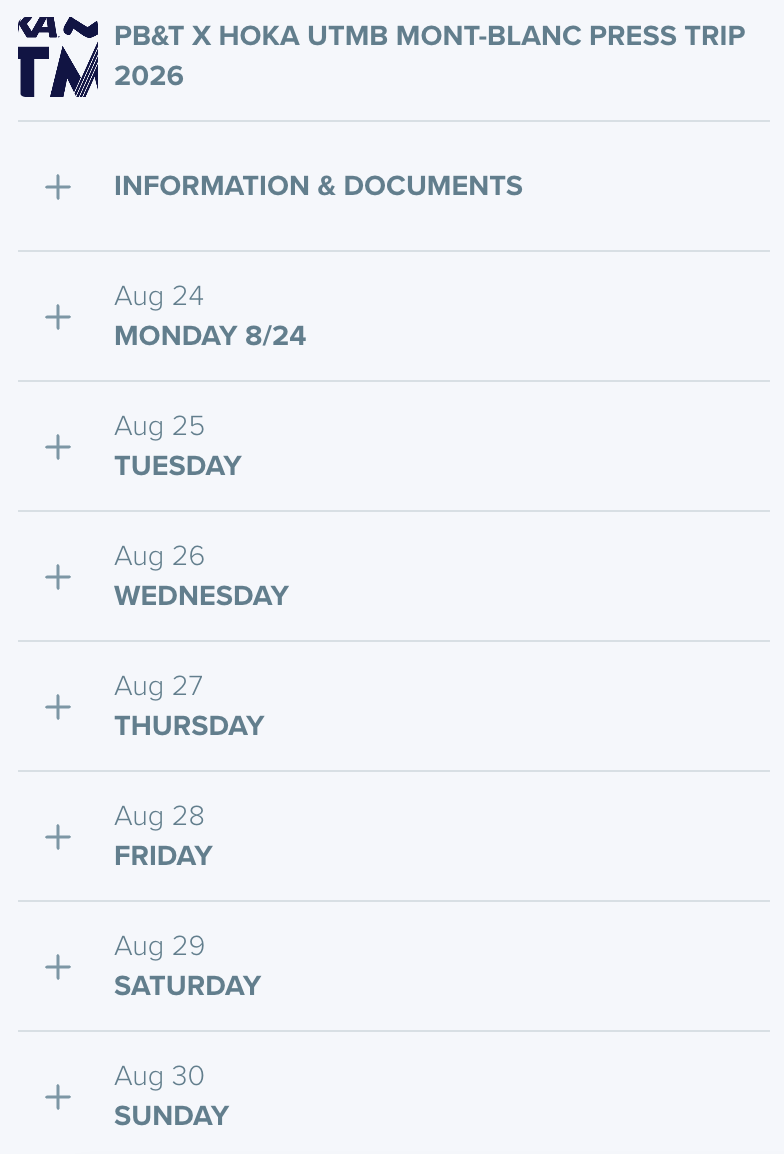
We’ll start by saying: HOKA sure knows how to plan an influencer trip, starting with the time and care they put into everyone’s itinerary. The actual document was highly personalized for each individual and sent weeks in advance, making the trip feel customized rather than one-size-fits-all.
Shoutout to the platform they used to share these out - Travefy - essentially a Google Docs-meets-travel-journal platform that updated in real time and served as a resource for everything from travel logistics to daily plans. Every detail was mapped out to the hour, complete with locations and timing, so you always knew exactly where you needed to be and when - even before the start of the trip.
If you work in influencer marketing or plan brand trips, 10000/10 you use this website.
TUESDAY, AUGUST 25
9AM: We landed in Geneva bright and early, and the very first thing we saw stepping onto the escalator down to baggage claim was a giant HOKA OOH placement. Considering a very large portion of people in that airport, passing by that ad were likely headed to Chamonix for the race, it was a smart reminder of the power of contextual OOH.
It also felt like HOKA asserting its dominance from the very beginning - becoming the first major brand to greet visitors before other footwear and performance brands followed with placements of their own. This is probably the only moment of the trip we didn’t get a photo of, but we still had to share it because it really set the tone.
11AM: The shuttle from Geneva Airport to our hotel in Chamonix took about an hour, and the van was filled with media like ourselves, spectators cheering on friends, and runners who had traveled in from places like Tokyo to compete. A truly global event, and the energy was high from the very beginning.
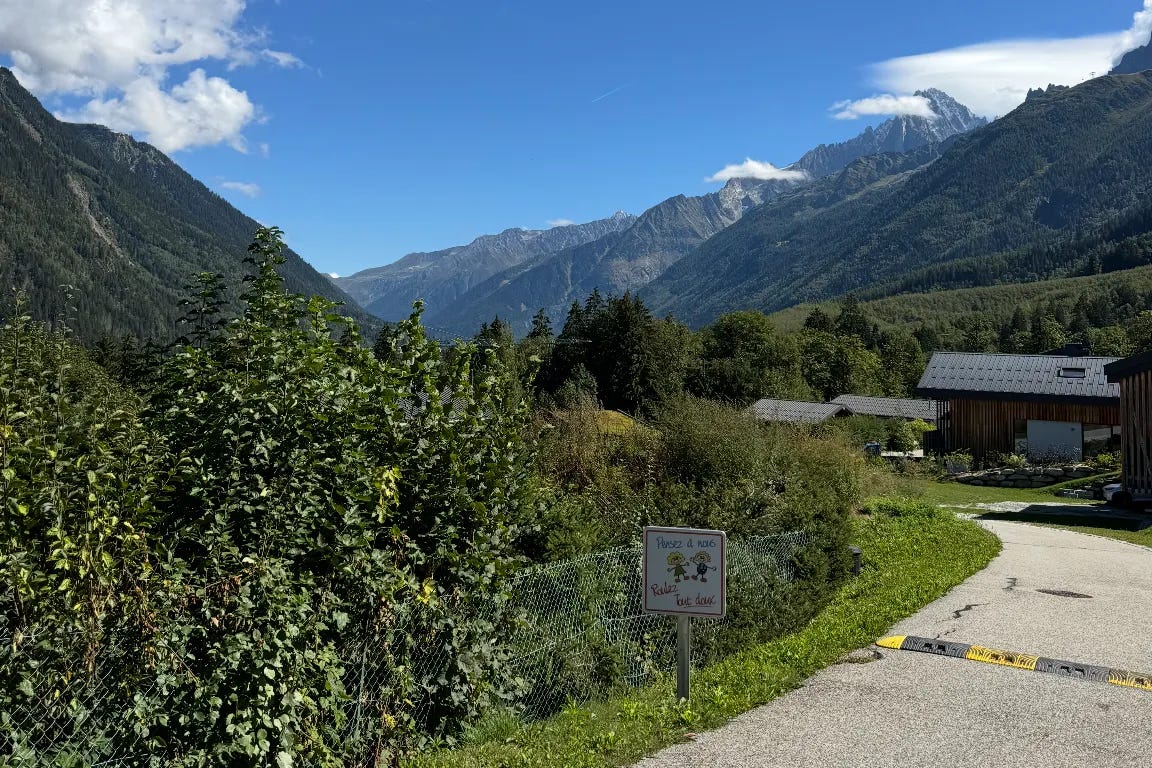
And talk about a scenic drive through an area smack in the middle of Switzerland, Italy, and France - the views were something else.
12PM: We arrived at the hotel and our room was decked out in all the HOKA apparel we could ever dream of - including two new pairs of sneakers sitting right on top. The pair in white and orange below is their brand-new sneaker - the Tecton X 4 - with the launch timed to the UTMB Mont-Blanc race.
The Tecton franchise is essentially HOKA’s high-performance trail racing shoe franchise, built around the Tecton X line that launched in 2022. This is the fourth shoe in the franchise, and their most breakthrough yet.


Beyond the sneaker itself, let’s talk about the room drop overall. We cover room drops a lot, especially when it comes to influencer and press trips, and the best ones usually put hospitality at the forefront. What we mean by that: it’s not just about putting a random assortment of products together, but choosing things that feel synergistic with the brand and relevant to the experience ahead. That’s why the Camp Snap cameras and branded HOKA disposables hit, as did the hiking gear, hats, and headlamps for nighttime experiences on the itinerary.
And, of course, the details make all the difference. Think of the branded HOKA coffee cups that could have been placed anywhere, but were hanging right above the coffee station. It felt like you walked into a HOKA showroom from the very first (official) moment of the trip, which just happened to be your room for the week. Epic.
1PM: We headed over to what Team HOKA called their “Media Suite” for the week, located right in the heart of Chamonix, on the second floor of a restaurant just steps from the finish line. In other words: about as central as you could get.
The space essentially functioned as a branded office, meeting point, and pop-up for HOKA’s media team throughout the week, with WiFi, complimentary beverages, and tables where you could work, looking directly into the center of town. What better way to write and cover the race than by feeling the energy firsthand - looking out the window and watching runners just steps away from the finish line?


Naturally, one of our favorite parts of the space was how the team brought the brand to life through the details. As you headed to the back of the first floor and up the stairs, there was a window display filled with HOKA-branded items - the Tecton X 4, bottles, rope, and other trail-running gear - with the HOKA logo stretched across the staircase, too.
Upstairs, HOKA blue and yellow window decals covered the glass alongside the brand’s logo and flying-bird emblem, while a TV played HOKA ads, specifically showcasing the new product. Speaking of the windows - across the street, you could see another building with HOKA-wrapped windowspanes. That’s when it really clicked for us: Oh, HOKA isn’t just here or there. They’re everywhere.
2PM: After visiting the suite, we grabbed a bite to eat and walked around town before heading over to see the finish line for ourselves. It looks exactly like it does in the photos online - set against the mountains, with a massive arch above the finish line covered in HOKA branding and a carpet leading runners straight to the finish, also featuring the HOKA logo. Only in Chamonix!


There’s much more to come on the races - stay tuned.
4PM: From the town, we headed to the first real event of the week: a happy hour kick-off with the entire HOKA team and guests, including influencers, media, and members of the broader team, at Alpina, a hotel right in the center of town. There was gifting for attendees, music, light bites, and fun arts-and-crafts activities - including a station where we could make custom bag charms and decorate bells to bring along for cheering on the sidelines.


We have to double-click on the charms, because this was another small detail that made the experience feel so thoughtfully connected to the trip. Each one was individually shaped, baked, and sealed by artist Becca Morgan for long-lasting color and style, drawing inspiration from outdoor adventure and everyday life. It was also a fun, low-pressure way to kick off the trip and give everyone an activity to do together while getting to know each other on night one.
7PM: And then came the kick-off dinner. We headed to Le Cap-Horn, one of Chamonix’s most iconic dining spots, which blends contemporary French and Japanese influences - think fresh seafood meets steak frites. Very much recommend if you ever go to Chamonix, one of our favorites from the week. And, of course, the thoughtful details continued: each person had a card waiting at their seat, welcoming everyone to the week ahead.


WEDNESDAY, AUGUST 26
6AM: Bright and early - well, still dark and early - we headed from the hotel to the FlyLab, HOKA’s massive consumer pop-up footprint at the Ultra-Trail Village. The Village featured a fan zone and specialized chalets where spectators, fans, and athletes could engage with leading brands across the trail-running world. And HOKA was front and center, with a two-story activation that immediately stood out from the crowd - a central theme here, if it wasn’t already clear!


We had the honor of visiting the FlyLab before the crowds arrived, where we got an inside look at the space and the innovation behind it alongside Jared Smith, Senior Product Line Manager at HOKA. He walked us through the evolution of the Tecton X franchise, with a wall showcasing the range over the years, including actual pairs worn by pro-athletes.
There was also a full rack of shoes available to try, including the option to take a pair out for a 24-hour trial, which we thought was especially interesting for a footwear category like this. But as Jared explained, feedback is one of the most important parts of HOKA’s product development process. And in an environment like Chamonix, letting people take the shoes out for a full day gives them the opportunity to come back with meaningful feedback.
You’ll see this theme of feedback throughout this letter. HOKA doesn’t just passively listen to feedback - they actively use it to inform the products they make and, in many ways, co-create those products with athletes.
And then there was our favorite detail: a large rectangular table with each side dedicated to a different component of the shoe, essentially “dissecting” the Tecton X 4 to show how each piece came together.


6:30AM: About 30 minutes later, the larger HOKA team - including the rest of the media and influencers - arrived for a 6K trail run, everyone instructed to wear their pair of Tecton X 4s and head-to-toe HOKA gear.


We run-slash-walked our way through it, but obviously had to share a few photos from the trail. Fun fact: the river is glacier water, so the temperature really drops the second you get anywhere near it - we’re talking at least a good 5 degrees.
10:30AM: Post-hike and breakfast at the hotel, the HOKA team set us up with what was probably the coolest activity of the entire trip: paragliding. Flying over Chamonix with the mountains all around you was wild, but our favorite part was probably seeing the branded HOKA parachute that someone flew under. So good!


4PM: In the afternoon, we took a cable car up for an après moment at HOKA’s activation at La Flégère. This was hands down our favorite activity of the entire trip.
Before we explain what La Flégère actually is, we have to talk about the journey from the cable car station to the mountaintop. Because HOKA didn’t just take over the activation at the top - they took over the entire experience getting there.
The cable car station itself was branded from top to bottom: HOKA flags and decals outside, the entire interior covered in HOKA OOH, and pretty much every touchpoint branded - from the signage along the ramp to the giant HOKA logo stretched across the floor, turnstile, a mini Tecton X 4 pop-up inside the station, branded water coolers, and even boxes to drop your tickets in after use.


And then there was the cable car itself: a fully wrapped, bright yellow HOKA car that stood out completely against the mountainside - the bottom featuring the HOKA logo, the front side with their bird emblem and the back reading “Let’s fly Chamonix Mont-Blanc.”


Now, let’s talk about La Flégère.” It’s the final major mountain checkpoint and climb on the UTMB course before the final descent into Chamonix. It comes after runners have already tackled 100+ miles and thousands of meters of elevation gain, with just 4.5 miles left to the finish line - making it a very emotional, exhausting, and highly anticipatory stop.
And why we loved this activation goes beyond the brand experience itself. Shocking, we know - but we’re strong believers that branding is best served with purpose, not just logo for logo’s sake. The best brand experiences understand the lives and situations of their consumers and tap into a real pain point or truth, rather than creating something that feels self-serving or simply additive.
HOKA didn’t just create a pop-up on the trail for the sake of having a presence there. They took over a major checkpoint and turned it into a cozy experience that gave athletes a moment to pause, recharge, and regroup - while also giving them access to HOKA’s new product in a moment where it could genuinely improve the athlete experience. That’s the difference between branding that interrupts and branding that adds value. HOKA understood exactly where their athletes would be, what they would need in that moment, and built the experience around it.


But yes, we’ll admit it: the branding job here was unbelievable. From the giant HOKA logo on the building - visible from the cable car as you approached the station - to cushioned pillows on every seat for athletes, shoe boxes, branded countertops, and even branded construction signage, HOKA came to life in every detail.
And then there were the little touches that made the space feel even more considered: outlet stations for athletes to recharge their devices, coloring stations set up on the tables, and branded flower vases throughout. Apparently, during the overnight runs, athletes even started competing to see who could make the best coloring. Nothing says recharge quite like arts and crafts.


7PM: We took the cable car back down to Chamonix for dinner on our own before heading back to the FlyLab for an “After Dark” experience. The evening kicked off with a nighttime 4K trail run through Chamonix alongside Lucy Georgia, a HOKA brand ambassador, before an immersive after-hours experience with music, curated light bites and beverages, and a hands-on FlyLab customization workshop.


At the very start of the evening, we had the opportunity to film a fun interview with Lucy, chatting all about her role as a HOKA ambassador, what she’d been up to with the brand throughout UTMB, and her advice for brands looking to partner with ambassadors - including what she thinks HOKA does best. We’re sharing the full interview on Instagram, but the photos above give you a little sneak peek.
And while we’re on the topic of ambassadors, we had the opportunity to interview Ellaney Matarese, a 23-year-old recent Harvard graduate who signed with HOKA to go pro ahead of her 100-mile debut at Western States. She also ran a race called OCC at UTMB this year - a 55KM race described on the UTMB site as the “ultimate challenge for mid-distance ultra-runners” - making this conversation very timely.
If you work at a brand interested in partnering with athletes, this is definitely a must-read. In Ellaney’s own words, there are so many ways brands can create an additive experience for athletes - actively helping them in their sport and supporting what they’re already doing - rather than making it harder for them to do their thing well. Here’s everything she shared:
Please note: Some responses may have been shortened for clarity and length.
PEOPLE BRANDS AND THINGS: You signed with HOKA earlier this year, ahead of your 100-mile debut at Western States. What has that transition into the brand actually looked like day to day?
Ellaney Matarese: It honestly all happened very fast. I went from graduating from Harvard with a plan to start medical school the following year, to jumping almost immediately into trail and ultra running, and then suddenly learning how to navigate being a professional athlete while I’m still learning the sport itself.
The day-to-day support I’ve had from HOKA has far exceeded what I imagined. Almost immediately after signing, ahead of Western States, I was invited to a team camp in Flagstaff that helped me feel so much more prepared going into my first 100-miler. But what has surprised me most is how much that support extends beyond training camps and race-day preparation.
I’ve gotten to work closely with the innovation teams on both footwear and apparel and give feedback on everything from sports bras and running vests to racing shoes. I’ve already tested several shoe prototypes, including one that the team modified specifically based on feedback I gave. It’s been really cool to see how seriously athlete feedback is taken and how quickly it can actually make its way into the product. I also really appreciate getting to contribute to products designed specifically with female athletes in mind. It makes me feel like I’m genuinely part of the development process and helping create better products not only for HOKA’s professional athletes, but for everyone who runs in their products.
PBT: UTMB is one of the biggest stages in trail running. From your seat, how does a brand like HOKA show up to support an event of that scale?
EM: From my perspective as an athlete, I think what’s impressive is the amount of support that goes into an event like UTMB beyond just putting athletes on the start line. There are so many moving pieces around a race of this scale, and having the HOKA team there means we have people helping us with the logistics and preparation so that when race day comes, our job can really just be to race.
I’ve already seen that firsthand in the lead-up to UTMB. HOKA has supported us with things like course reconnaissance, transportation, lodging, and aid while we’ve been out training on the course. Even before race week begins, there’s clearly a lot happening behind the scenes to make sure we have what we need to feel prepared.
But I also think HOKA’s presence goes beyond just performance support. UTMB is such a huge gathering of the trail-running community, and HOKA really embraces that. They bring athletes together, create opportunities for us to spend time with one another and with the broader running community, and make the week feel like something bigger than simply showing up for your individual race.
PBT: What does it mean to you to be racing UTMB MB as a HOKA athlete specifically?
EM: I would never want to represent a brand that I didn’t genuinely believe in, and HOKA is a brand I’m incredibly proud to represent — from the products, to the people behind them, to the athletes I now get to call my teammates. Over the past few months, I’ve gotten to see firsthand how much care goes into both the products and the way HOKA supports its athletes, and that has only made me prouder to race as a part of the HOKA team.
UTMB is one of the biggest stages in our sport, so getting to line up there for the first time wearing HOKA feels really special. I’m still very early in my trail-running career, and to have a brand believe in me at this stage and give me the opportunity and support to pursue some pretty big goals means a lot. I want to represent HOKA in a way that reflects how grateful I am to be part of the team and hopefully making them proud to have taken a chance on me.

THURSDAY, AUGUST 27
9AM: In the morning, we had the opportunity to sit down with Colin Ingram, VP of Global Footwear at HOKA - big job.
This was the perfect conversation to kick off our new MAKING BRANDS AND THINGS column running throughout September, with a deep dive into all things product development. It’s not quite September, but we just couldn’t wait, so here is a mini edition to kick things off. We talked about Colin’s personal ethos when it comes to creating new things at the brand, HOKA’s approach to product “briefs,” and how the product and marketing teams collaborate internally to bring new ideas to life. And, hint: it’s rooted in the power of storytelling.
PEOPLE BRANDS AND THINGS: Can you speak to your grounding ethos when it comes to product development and leading this team to develop new products?
Colin Ingram: For us, when it comes to building new products, it kind of goes back to the first days of the brand. Obviously, it was born here in Chamonix. The brand itself was very much built around the idea of solving unique problems. It was born literally to run down a mountain as fast as possible, with the least amount of impact as possible. So that creates a very unique problem to solve.
But what it did was actually create an experience and a sensation that became much more widely coveted, right? So the reason I point that out is that’s how we start all product ideation. What experience are we trying to deliver?
And what’s going to be that epiphany moment for a consumer to make sure that they get in it and know immediately what we’re trying to do with the product, instead of having to be told with a bunch of bullet points and tech points exactly what it is that they should care about? They should very easily know what they’re getting after in the first place. So that’s kind of the first ethos that we get after: the experience and the sensations.
PBT: How do you balance creating product for the most elite athlete, but also the everyday athlete?
CI: Yeah, it’s really a unique place to be, to be honest with you, because it’s one of the things that drew me to the brand in the first place. What I love about the brand in particular is that it is very authentically a beginner’s brand and an elite brand at the same time.
And that’s a really difficult scale to cover. But if you are somebody who’s coming to movement for the first time and figuring out what it means to you, we’re a very approachable brand. You know, it’s a shoe that you can get on, it feels soft, it allows you to run in maybe a way you didn’t think you could, or try something scary you didn’t think you wanted to try. But then on the elite side of things, it’s like the go-to tool to get you to be the fastest you possibly can be.
And that’s, again, really, really unique in that sense. So, when we look at those two things and look at athletes and everyday consumers, while there are differences between them, there’s actually more similarities than differences. Our athletes just happen to be the super users of everything that we do. They take it to the nth degree. They put the most mileage in, the fastest. They are doing the most extreme things, and so they can break it, we can fix it, and we can learn from them.
But vice versa, from our consumers, everyday consumers who are learning and introducing themselves to the brand, we get to see how that translates and whether the messaging even makes sense by the time it gets to a mass market, right?
So, for us, the balance of those two things is really important, and it’s, I think, why HOKA comes across with a unique personality, where our ears are open, but we’re also not afraid to just be us and give you a point of view as to what we think that next great experience will be.
PBT: How is your team structured on the product side?
CI: Yeah, there’s a lot of hands that go into touching every single shoe, for sure. When you think of the expertise that needs to come in, you can’t be a jack of all trades in building great product. You need experts, and kind of like a consortium of experts in that sense.
When you think about Jared, he’s the one briefing the product. He’s the one who’s building out the storytelling, letting everybody know who’s going to be wearing it, why they’re going to be wearing it, how is it going to sell in market, painting the picture.
We have our design team, which is built up of product designers, 3D concept designers, material designers, and color designers that bring the visual and the actual design, and, like, the thing you fall in love with, to life.
And then on the other side of the equation, we have our development team. So, wear testing, material development, and even our actual product developers themselves that help us build the thing. You know, the reality, where the rubber hits the road, they’re the ones that get to tell you whether the road’s working or not.
And so that kind of balance of all those three components brings together what is, like, the final product that you see there.
So, it’s a lot of hands that go into it, that expertise. Everything from the material on a shoe, to the fit of the shoe, to the overall function and durability of it has input from all those pieces, and it’s a bit of a symphony to get it there, for sure.
PBT: When you talk about the initial product brief, what does that look like? How does a product brief look different than, let’s say, a creative brief?
CI: I mean, honestly, just using Chamonix and trails as an example, great product briefs have great stories. And the stories are built around not the product itself, but what it enables you to do, or a problem or an experience that it’s allowing you to solve or take part in that you didn’t before, right?
So, even the Tecton, like, we have, like, it’s not a traditional carbon plate. It’s a split plate. There are two in the shoe because we were trying to balance out propulsion and stability and malleability on the trail.
And those types of things, those stories and the how and the why of everything, is what gets to be repeatable. So, from the brief to the marketing brief to what the consumer sees, it’s the same thread all the way through, as opposed to it having to be reinvented every time a new team picks it up and having to be a game of telephone for what the intent and the storytelling of the product needs to be.
So, that first anchor point around storytelling and having that sticky concept of “why” is really where we start.
PBT: And that brings us to the Tecton X 4. Can you tell us the origin story of this new shoe?
Colin Ingram: Tecton X 4 is a great example of all things clicking on all cylinders, whether it’s athlete input, obviously the brief writing we just talked about, but also the end product delivering on what an everyday consumer would need as well.
This is the fourth version of a shoe that we iterated starting in 2021, that was built around a new concept for bringing what was a big topic of conversation in carbon plates and superfoams in road to trail.
So, we wanted to be on the front end of that conversation, and the way that we decided to do that was by kind of taking the core concept of the time, which was the carbon plate in the shoe, and making sure that it wasn’t a traditional approach and an unstable approach.
We took that carbon plate and split it. And we did a unique thing. That’s why it’s called the Tecton. There’s the shift that happens with those plates that allows you to create a scenario where you have variable terrain that a shoe can adapt to, but still be propulsive.
So, when it comes to this shoe itself, over years of iteration of that concept, the same concept still lives within this. But more importantly, through athlete feedback, and inclusive of a couple of wins here at UTMB that we were fortunate to have, really dial in the upper and make sure that this is a fully 360-degree design shoe that really mirrors it to your foot and feels incredible as you get onto it.
PBT: How do you think about innovation within an existing franchise like the Tecton X 4? How do you balance athlete feedback with category innovation, learnings, and competitive insights to inform this development?
CI: The way we look to improve and develop some of the unique aspects of each of these that we’ve just gone through is from a broad range of inputs.
There’s obviously advancement in materials, which is great, and we can test and learn and try in those. There are advancements in process and manufacturing that help us push the envelope there as well.
But then there’s also getting back to the athlete feedback side of things. That’s a major piece of where we take this. And in many cases, those of us in the brand who are runners and happen to be the right size here as well spend time in the product.
This isn’t just a beautiful museum piece that we’re looking to make sure is set up and looks beautiful on a shelf. We actually need to feel confident that we are building it the way it needs to be as well.
So, that’s a major component, too: having it on foot for both internal, external, and athlete testing. Manufacturing and materials and those types of things.
While it’s nice to look at competitors and see what they’re doing, in many cases, what that does is show us where we need to zig toward to be unique as well. We try not to be a “me too” brand in that case. And it’s something we like to really celebrate the challenge.
12:45PM: After the interview and a quick lunch, we headed into town to watch the world’s best trail runners close out the OCC. Those runners had set off early that morning, so by around 1PM, the first athletes - specifically the podium finishers - were starting to come through.
As a team based in New York City, we’ve gone to watch the NYC Marathon year after year, but this was something else entirely. It felt like the entire town - locals and tourists alike - had come out to watch and cheer from the sidelines. People were packed along the streets, with others watching from balconies with Mont Blanc casually sitting in the distance. It felt like you stepped into a storybook.


And, as we mentioned earlier, HOKA branding was front and center. We watched from the HOKA VIP viewing area, while the media pit gave us a first look at just how thoroughly the brand had taken over the final stretch - from the last few feet leading into the finish to the finish line itself.
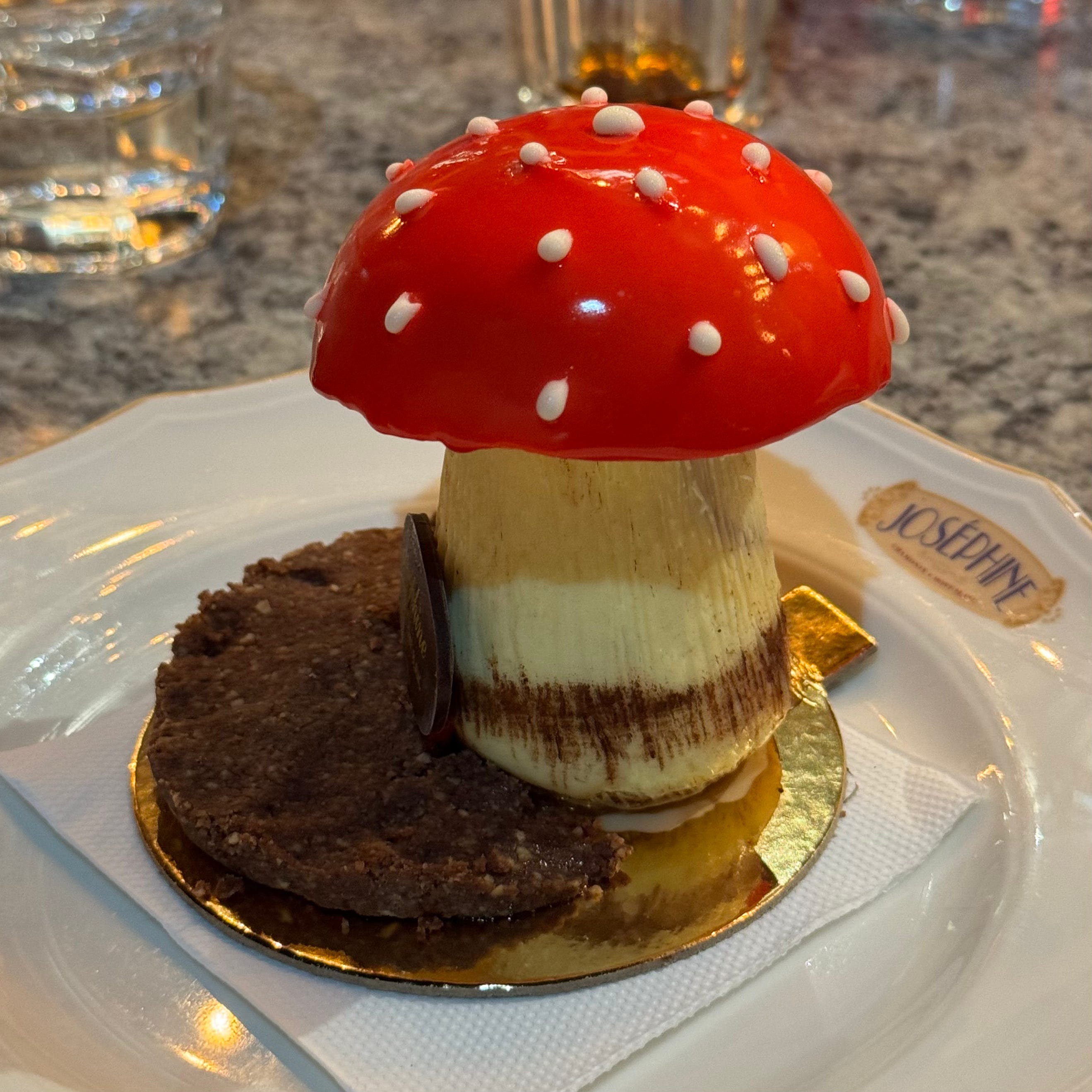
7PM: Group dinner at Josephine - no photos except this image of the adorable mushroom-shaped dessert. Had to share.
FRIDAY, AUGUST 28
8AM: We headed out on a trail run-slash-hike, led by Lucy Georgia, to the Le Dard waterfall, with everyone in head-to-toe HOKA shoes and gear, of course. The hike culminated at La Cascade du Dard before we made our way back down.


5PM: After a long break in the afternoon, the entire HOKA team - we’re talking 100+ people who came to Chamonix with the brand - boarded a bus to Biche in Les Contamines-Montjoie, right along the UTMB course, for a front-row view of the runners passing through one of the race’s early aid stations.
And in classic HOKA fashion, as we learned throughout the week, this wasn’t just a gathering in the middle of the mountains to watch people run. The entire cabin-like house and outdoor space was filled with thoughtful branded moments - HOKA flags greeting you as you arrived, the same chairs we’d seen up in the mountains for a comfortable viewing, tents set up in the middle of the field to keep everyone entertained, and more.


This ended up being one of our favorite moments of the entire week. Risotto stations and drinks eventually turned into a full-on dance party, with everyone pulling out their headlamps and dancing in the dark to keep the energy going. HOKA can plan a trip, but they really know how to party, too.
At around 10:45PM, everyone collectively got up and headed to the field, lining the raods to cheer on the runners as they came through. HOKA-branded bells, hats, and other gear were handed out, and suddenly this cold, rainy night aid station felt like a stadium of sorts. We’ll never forget it.
SATURDAY, AUGUST 29
4PM: After a slow morning and early afternoon, we headed into town to watch the podium finishers cross the UTMB finish line, both the men’s and women’s races.
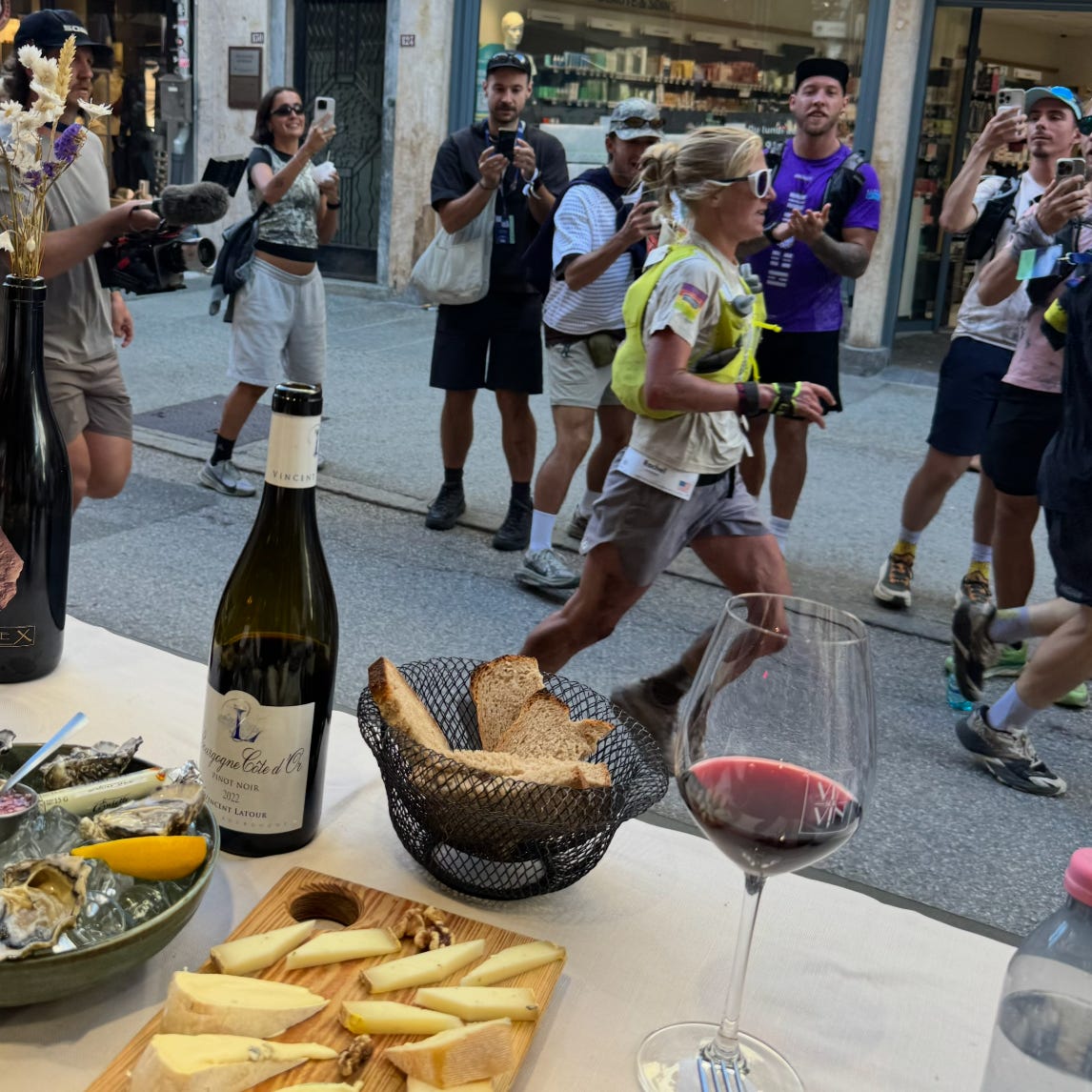
On the men’s side, American Ben Dhiman became the first person to break the 19-hour barrier, finishing in an insane 18 hours and 16 minutes. On the women’s side, Blandine L’Hirondel led the group, followed by American Rachel Entrekin, who we actually caught a glimpse of while grabbing some wine and cheese - only in France!
7PM: At night, we headed off to close out UTMB week with HOKA at their closing party at La Folie Douce.


There was plenty of food, drinks, merch - including a HOKA plush toy - and even a beverage that was supposedly created to help digest all the cheese you’ve eaten on this trip. (True story.) And, naturally, the branding was everywhere: HOKA flags throughout the space, a mountain-shaped photo drop, a bar featuring the HOKA emblem, and more. And an incredible sunset.
And that’s a wrap!
A huge thank you to HOKA for a week of a lifetime. They’re truly at the top of their game when it comes to the the Brand meets Sport conversation, but more than that, they’ve mastered how to bring a brand to life in a way that feels additive and part of a much larger universe. From the product to the experiences to every tiny branded detail, HOKA is the prime example of what happens when you fully commit to building a world around your brand.
HOKA stans forever.
Really enjoyed the ‘diary entries’
I'm exhausted just READING this. Damn, the Hoka team killed it!!!! Loved this diary style of storytelling as well